

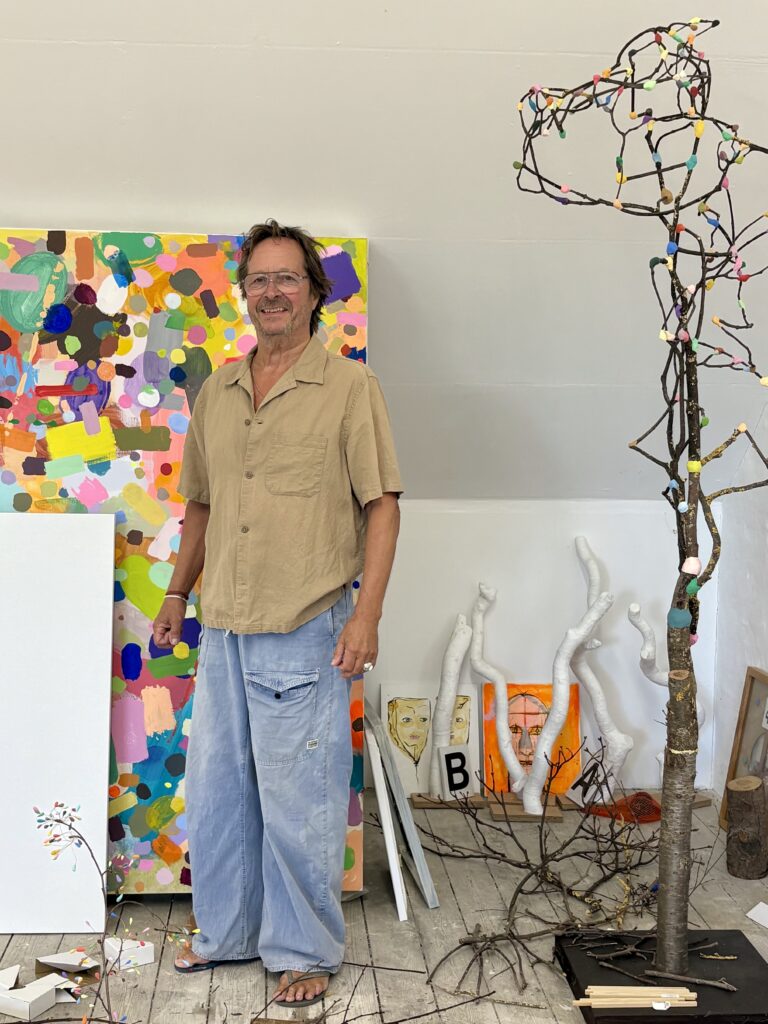
IN CONVERSATION WITH HAN RAMECKERS
By Isabel Ferreira de Sousa
In his studio, Han Rameckers talked about his fascination with colour, his use of unconventional materials, and why certain artworks remain current.
How did you come into contact with art?
As a child, it was mainly through pictures and paintings. I remember seeing Dali’s paintings and finding them fascinating. Later, as a student at the Art Academy, I went to a museum for the first time and was exposed to art on a daily basis. Of course, my understanding of art changed as I got older – you move beyond beauty, from an aesthetic sense, and start looking deeper.
You work accros mediums – painting, mixed media, drawing, and sculpture. Is this important to you?
Yes, because it allows me to discover more about myself. I’ve been drawing since I was a child. Then, at the Art Academy, I got a piece of clay in my hands for the first time and a new spectrum opened up – I started making sculptures and other three-dimensional work. More than working with different media, I started experimenting with size and scale. I realised I could do something small and precise, but also something monumental.
What determines the size of a specific work?
The moment. Larger works often emerge from small things that I come across or that catch my attention. From the moment I start working on a piece, its size becomes clear.
You also work with waste material. What does it do?
I enjoy the diversity. Besides oil, acryl and watercolour, I collect waste material – plastic, metal, cardboard, glass etc – and use it to make sculptures. I usually paint it black to bring it to a coherent whole. It is also a way of giving something a second life: something that was thrown away becomes valuable.
Besides different media, are there certain themes that you are drawn to?
I’m fascinated by nature and by human beings, in both their actions and thoughts. That’s where the artwork SexPowerMoney comes from. To me, these three pillars are interwoven. I first created the first work of this series 15 years ago, and it is still relevant nowadays – just look around, especially at world politics, and you’ll see people with power and money doing whatever they want.
Lately, I have been showing work from 40 years ago alongside more recent one, and you see how history repeats itself.
Would you say part of your work has a political charge?
I’d call it a human charge, but in politics you see it more clearly.
Besides SexPowerMoney, can you tell something about the other two artworks for Alma Archive?
Happy Tree, the small sculpture in the bell jar combines my love for nature and for child-like materials like clay. By mixing basic colours, you get a wide range of tones, just like with paint. Children’s work is usually playful and that’s something that appeals to me. Nature, with its beauty, power and everything it offers us is also a recurrent element in my work. In this specific piece, I give a dead branch a new life.
The third work, Wire Construction – Wave #1 is about composition. It’s colourful and child-like. And that’s what I like to do. The colours highlight the connections between the wires – through the dots, the work continues to exist; otherwise, it would fall apart.
What is your relationship with colour?
For me, colour is attention. Through colour, you can draw the eye to something. Just take, the LGTBQ flag, for instance, it creates impact. I’ve also noticed that people feel happy when they stand next to my artworks, and that’s something that gives me great satisfaction.
As an artist, I have the freedom to do whatever I want. Still, I think it’s essential to learn about colours. You can use every colour system; it just depends on what you do with it. Sometimes I change colours, for instance when I’m working on a painting, not for harmony, but to create a certain dynamics; otherwise it would disappear into the whole.
Looking back on your career, would you say you’ve been working in a specific direction?
No, I don’t really have a direction. It is more the freedom that you allow yourself. I only make what I want. After graduating from the Art Academy in 1982, I got this studio, and I’ve worked here ever since. There are certain things that have had an impact in my work. One is talking to other artists – for me talking about art is a way to discover myself. The other is personal circumstances. At that time, both my father and my brother were seriously ill, and this motivated me to draw. It was almost therapeutic: a way to express the sadness and pain that are inherent to life, to draw it out of you, and give it shape. That has always stuck with me.
Colour and working with discarded material came later. I spent two months in Africa and that was a great experience and source of inspiration – that is when colour came in. In Africa, I realised that happiness was not only the absence of a broken leg or arm; it is also in your head. I saw a lot of smiling people, despite all the hardships, which was very different to what I was used to in the Netherlands. The same went for to waste: people used and repurposed everything they found.
Do you have any plans for the coming years?
Not really. I want to continue doing what I do. I want to keep exploring colours as colours and the freedom of a space: open spaces, closed spaces. I don’t know exactly what yet. It will unfold as I go.